Wednesday, June 20, 2007

less is more expensive, sometimes

Reflected Farmhouse, left, designed by Peter Gluck illustrates the expense of minimalism, primarily because craftsmanship is visible and must be perfect. Using natural materials for ornament, pioneered by Adolf Loos and Frank Lloyd Wright, are often expensive, too. Gluck is so attentive to the production of his work and concerned with quality control, that he formed his own construction firm. Does this entirely answer why should less be more expensive? As consumers begin to exert greater control over production possibly quality, durability, design excellence, and low maintenance products will gain greater market share, although touring any new suburb, ecomodista despairs the current status of mass housing design. Perhaps Lot-ek's prefab container modules will prove popular (http://www.lot-ek.com/). Container Home Kits are available.

See also http://www.trendwatching.com/briefing/ for their monthly briefings, especially Crowd Clout.

Another issue posed by minimalism is storage. For an interior to appear minimal, yet work, storage must either be built into the walls and modules, or eliminated by minimal consumption, possible for only the most austere consumer. Adolf Loos' Müller Villa is one of the earliest examples of built in furniture and storage. Amazingly, when photographed by ecomodista, the silk upholstered built-in couch was still intact, although threadbare. Threadbare is definitely preferable to replacement of the upholstery.


Monday, May 14, 2007

müller villa, prague, adolf loos, architect, 1928; copyright carla breeze 2007

less is more green

muller villa, adolf loos, architect, photograph copyright carla breeze, 2007

less is more green

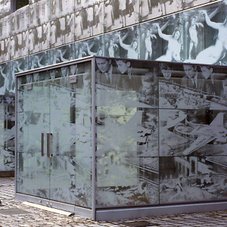
Don't be concerned, the following actually does segue into less is more green. Techniques for body ornament, such as piercing and tattooing have been applied to architecture since the inception of modernism. The Library at the Eberswalde Technical School in the former DDR (East Germany), designed by Herzog & de Mueron is a contemporary example. The project consists of bands of concrete alternating with glass, which have windows. Doors occasionally pierce the walls of this small but elegant structure. According to Herzog, “The Eberswalde Technical School Library is a collaboration with [artist] Thomas Ruff, who collects photographs from magazines and newspapers, frames and exhibits them. The concept of tattooing a body is an archaic means of decoration, an issue which I find alluring.” He remarked that Adolf Loos' Ornament und Verbrechen (Crime Against Ornament, a collection of essays published in 1908) was totally unappealing to him and that the desire to ornament is a human tendency. Austrian architect, Loos, despised applied ornament and advocated the use of materials instead, well illustrated by the 1928 Müller Villa in Prague.

Crime Against Ornament proposed the theory that the use of applied or superficial ornament was the result of criminal degeneration. Directing his tirade at Secession architects such as Henry van de Velde, who designed houses, housewares, hardware, and even his wife’s dresses, Loos believed ornament should derive from the materials used for construction, not the economically enslaved populace who produced ornament. This ethical position would seem to coincide with Herzog’s own use of materials evinced in the Tate Modern.

Loos was openly derisive of one of the last decorative styles at the end of the 19th century, the Secessionist movement. Not only did Loos design extraordinary houses he was equally involved with fashion, editing a men’s fashion journal for a brief period. To illustrate the Secession’s obsession with designing every facet of life he related this anecdote, “Once it happened that [a client] was celebrating his birthday. His wife and children had given him many presents. He liked their choice[s] immensely and enjoyed it all thoroughly. But soon the architect arrived... He entered the room. The master greeted him with pleasure... But the architect did not see the man’s joy. He had discovered something quite different and grew pale. ‘What kind of slippers are these you’ve got on?’ he ejaculated painfully. The master of the house looked at his embroidered slippers. Then he breathed in relief. This time he felt quite guiltless. The slippers had been made to the architect’s original designs. So he answered in a superior way, ‘But Mr. Architect! Have you already forgotten? You yourself designed them.’ ‘Of course’ thundered the architect, ‘but for the bedroom! They completely disrupt the mood here with these two impossible spots of colour. Can’t you see that?’”

The alternating glass and concrete bands of the Eberswalde Technical School Library allude to similar bands of glass, cladding material, and steel of skyscraper construction. The basis for modern architecture is not only the series of engineering feats originating during the late 19th century in Chicago, but an ethical position, not unrelated to the current emphasis on sustainable living. Minimalism in architecture and design continues to be a viable strategy and ecomodista even advocates minimal consumption.

Peter Gluck is the first architect to receive a LEED Silver rating for an affordable housing project, Little Ajax in Aspen, Colorado. Gluck designed the Kaplan Residence in Chicago, using a melange of materials, wood, copper, and stainless steel in this opulent, but minimalistic home.

Wednesday, May 2, 2007

deconstructing adobe


ecomodista is working with adobe master Albert Parra on repairs to the property, and in the course of discussing this with him, remarked how the horno should be torn down because it had been stuccoed with cement rather than the traditional mud slip. Because an horno needs to breathe while bread is being baked, we must build a new one. Albert suggested he rebuild it with us for a documentary being made by the Smithsonian Institution, so suddenly ecomodista has a deadline, and to style the photo shoot it is critical to remove the asphalt in the parking area.

sustainable style


Artists,Tom Mullaney and Andrea Ackerman's loft in Williamsburg; table constructed by Mullaney with recycled plastic lumber. Is recycled plastic lumber a sustainable strategy? Certainly as a material, it out performs wood in terms of maintenance and composed of "renewable" resource, if one considers plastic recycling a resource.

Yesterday ecomodista obtained an estimate to remove the asphalt parking lot at our apartment compound because it is a massive heat sink, essentially an environment that absorbs and dissipates radiant (the sun) heat. The visible vapor above an asphalt road in the summer perfectly illustrates this issue.
To implement sustainable concepts for our adobe apartment compound, we are first tackling the low tech solutions, such as asphalt removal.

Asphalt surrounds our cities, and if in the summer, the temperature in New York City was measured in midtown, rather than Central Park, there would be an increase of 10 to 15 degrees F. Asphalt is not only used for highways, as ecomodista discovered to her dismay when she purchased adobe blocks, torrones, from a vendor in the North Valley in Albuquerque. Most adobe bricks are stabilized, generally by mixing a small percentage of concrete into the mud. Hybrid adobe is also being explored, and is a great way to recycle weeds and garden cuttings. This would not affect degradation resulting from exposure to water, which is why most adobes are stabilized. For reference see: http://www.hybridadobe.com/how_to.shtml

ecomodista bought adobes for repairs in one of the units, and intended to order a truckload to rebuild the horno (adobe oven used by indigenous people for baking bread or firing pottery). When told that the bricks were stabilized with asphalt, she inquired about non-stabilized adobes, and the vendor remarked that he made these only in May and June when women from the Pueblos bought them for their hornos. He scoffed at the idea that these women found bread baked in hornos constructed from stabilized adobe tasted like a petrochemical.

Asphalts are bituminous materials which occur naturally or are derived from nondestructive separation of petroleum fractions. Typically, this is achieved through fractional distillation or solvent de-asphalting. Asphalt should not be confused with tar, which is obtained through destructive processing of coal, wood, or petroleum. Asphalt contains aliphatic hydrocarbons in addition to the mononuclear aromatics and polycyclic aromatic hydrocarbon (PAH) mixtures found in asphalt & tar.

The National Park Service,
Water Resources Division, has published an Encyclopedia of Contaminants by Irwin, R.J., M. VanMouwerik, L. Stevens, M.D. Seese, and W. Basham which contains the following information:

"The primary hazard associated with asphalt arises from PAHs and alkyl PAHs in asphalt that can move into the ecosystem from the breakdown of asphalt. Since asphalt contains so many toxic and carcinogenic compounds and since leaching of harmful PAH compounds has been documented even in water pipe use, asphalt should be kept out of rivers, streams, and other natural waters to the extent possible NIOSH urges caution related to human exposure to asphalt. Current NIOSH research indicates that asphalt products are carcinogenic to laboratory animals and, therefore may be more toxic to humans than previously believed [366]. Air concentrations of PAHs have been shown to increase to potentially dangerous levels in National Parks in response to forest fires and asphalt roads burned by lava flows; although the human health risks from low levels of PAHs is not precisely known, the National Institute of Occupational Safety and Health position is that any exposure to certain carcinogenic PAHs is too much and therefore the exposure should be limited as much as possible."

After reading this information and other research, ecomodista's decision to remove the asphalt is confirmed, and the asphalt that is removed can be recycled, although the consumer pays for recycling. Gravel and red crushed rock will replace the asphalt, preventing flooding, and allowing precipitation to reach the aquifer under Albuquerque.

Monday, April 16, 2007

dyeing to recycle

Designer, Gianni Lauren, formerly with the boutique, Burrow in SoHo (now relocating to Nolita), paints recycled t-shirts with dyes and uses safety pins as closures. Burrow represents designers working with recycled materials. Mary Jaeger is producing incredible shibori dyed t-shirts, and although the website hasn't been updated since 2005, it's worth looking at,unless you happen to be in Nolita, http://www.maryjaeger.com/sp05/index.html

Feeling guilty about using Durock, ecomodista is still researching the environmental impact of concrete, and because the weather is gloomy, will dye a few garments that need brilliant color. This is an excellent means of recycling clothing that happens to be last season’s color or simply the wrong color. Dyeing a darker color over a pale shade is definitely easiest. For many years, ecomodista didn’t care what color she bought, as long as it was silk, cotton, cashmere or wool, it could be dyed black, favored by those New Yorkers laboring under self imposed sumptuary laws, mandating black--black sweaters, black skirts, black trousers, black jeans, etc. I bought quart cans of Deka black dye at Pearl Paint.

German dyes are most effective, especially those designed for batik. Unfortunately Deka is no longer available in this country, so ecomodista is using vegetal dyes when possible or Leight & Bunt manufactured by Marabuwerke GmbH & Co founded in 1859 by Albert Martz in Stuttgart, Germany.

If you are wondering if dyes are toxic, see Paula Burch’s site, which has technical information regarding the various types of dyes. Queried whether Procion dyes are safe, Deka is also discussed:
http://www.pburch.net/dyeing/dyelog/B1063361308/C1307213733/E1925627151/index.html

OSHA, http://www.osha.gov/SLTC/textiles/index.html and the CDC have information regarding the safety of chemical dyes, and personally I use a respirator whenever using ANY material with particulates.
Another site with useful safety information is: http://www.ci.tucson.az.us/arthazards/text1.html

You get the point. Generally, natural dyes have numerous advantages in terms of safety. An excellent source of black may be derived from black walnuts, in fact, the dye is so intense, wear disposable gloves when picking these in late autumn.


See: http://www.mannamcarpets.com/dyeBr.html for instructions using walnut bark to make brown dye and for other websites,

All Fiber Arts is an excellent resource, including instructions for natural dyes, including cochnineal derived from the insects, Dactylopius coccus, inhabiting prickly pear cacti and a recipe for indigo derived from Indigofera tinctoria and Indigo suffraticosa. Indigo for commercial use is synthesized. In temperate climates indigo is obtained from woad (Isatis tinctoria), indigenous to Europe, and dyer's knotweed (Polygonum tinctorum) from China, Japan and Korea. These plants have been considered inferiorsources of indigo dye because they contain less indigo than the tropical indigofera. Modern analysis shows that this assumption may be incorrect and a result of inefficient processing and poor understanding of the dye. Farming dye-bearing crops is enjoying a renaissance as people in western countries look further and further into a more organic and sustainable lifestyle.
See:
http://www.allfiberarts.com/


construction detail of michael reynolds earthship